Beyond Temporal Difference: A Divide-and-Conquer Approach to Reinforcement Learning
Introduction
Reinforcement learning (RL) has made remarkable strides in recent years, yet many algorithms still rely heavily on temporal difference (TD) learning—a method that struggles with long-horizon tasks due to error propagation. This article introduces an alternative paradigm based on divide and conquer, which sidesteps the limitations of TD learning and scales effectively to complex, multi-step problems.
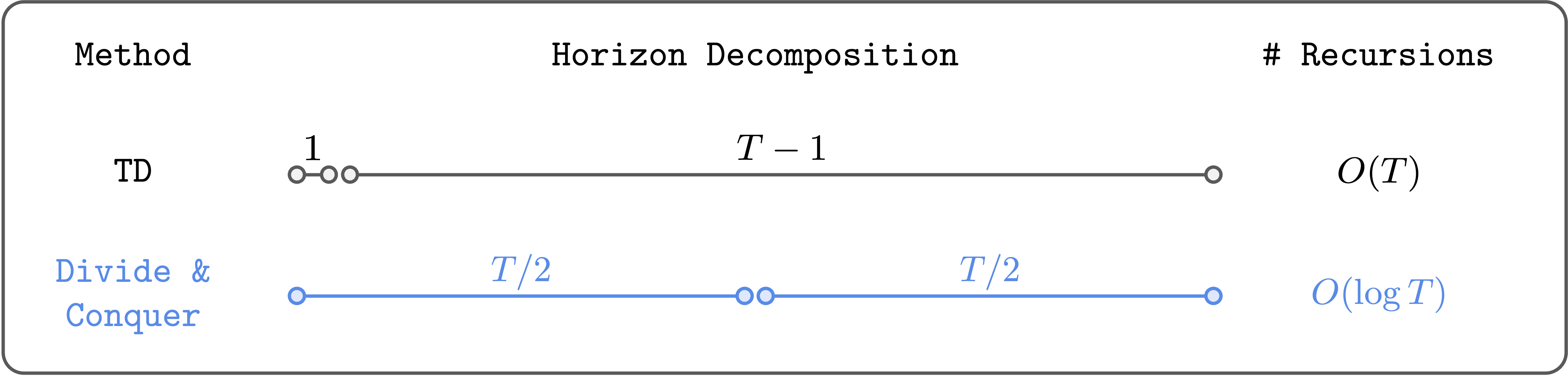
Instead of bootstrapping through successive value estimates, the divide-and-conquer approach breaks a long task into smaller, manageable subproblems, solving each independently and then combining the solutions. This not only reduces error accumulation but also enables more flexible use of off-policy data—a critical requirement for domains like robotics, healthcare, and dialogue systems where data collection is expensive.
Understanding Off-Policy Reinforcement Learning
Reinforcement learning algorithms can be broadly categorized into on-policy and off-policy methods. On-policy RL (e.g., PPO, GRPO) requires fresh data collected from the current policy; old data must be discarded after each update. Off-policy RL (e.g., Q-learning) has no such restriction—it can reuse past experiences, human demonstrations, or any available data, making it far more flexible.
Off-policy RL is especially valuable when data is scarce or costly to generate. However, designing a scalable off-policy algorithm remains a major challenge. As of 2025, while on-policy methods have matured, off-policy algorithms that handle long horizons reliably are still elusive. The core difficulty lies in how value functions are learned.
Two Paradigms for Value Learning: Temporal Difference vs. Monte Carlo
Off-policy RL typically trains a value function using temporal difference (TD) learning, such as Q-learning, with the Bellman update:
Q(s, a) ← r + γ maxa' Q(s', a')
The problem with TD learning is that errors from the next state’s value propagate to the current estimate. Over many steps, these errors compound, making the algorithm brittle for long-horizon tasks. To mitigate this, practitioners often mix TD with Monte Carlo (MC) returns, using n-step returns:
Q(st, at) ← Σi=0n-1 γi rt+i + γn maxa' Q(st+n, a')
This reduces the number of bootstrapping steps by n, thereby limiting error accumulation. In the extreme case of n = ∞, pure Monte Carlo learning is recovered. Yet this approach is not fully satisfactory—it doesn't fundamentally eliminate the reliance on bootstrapping, and choosing the right n can be task-dependent.
A New Paradigm: Divide and Conquer in RL
Instead of incrementally correcting value estimates through bootstrapping, the divide-and-conquer algorithm reframes the problem at a higher level. The key idea is to decompose a long-horizon task into a hierarchy of subtasks, solve each subtask independently, and then combine the results to form a global policy.
This approach has several advantages:
- Reduced error propagation: Each subtask has a shorter horizon, so errors within a subtask do not cascade across the entire task.
- Improved sample efficiency: Subproblems can be solved using any off-policy data, including unrelated experiences, human demonstrations, or even simulated data from abstract models.
- Natural scalability: Long tasks are broken into pieces that can be processed in parallel, mirroring how humans tackle complex problems.
The algorithm does not rely on TD learning at all; instead, it uses subgoal discovery and local value functions that are learned via Monte Carlo returns within each subproblem. Since each subproblem is short, Monte Carlo estimates are stable and accurate.
How Divide and Conquer Works
The algorithm proceeds in three phases:

- Task decomposition: The original Markov decision process (MDP) is partitioned into a set of sub-MDPs, each covering a segment of the state space. The boundaries between sub-MDPs become subgoal states that act as “relay points”.
- Local learning: For each sub-MDP, a local policy and value function are learned from collected transitions. Since the horizon within a sub-MDP is short, standard Monte Carlo returns work well, and bootstrapping is unnecessary.
- Global composition: The learned local policies are combined using a high-level controller that decides which subgoal to pursue next. The high-level controller can be a simple rule-based system or a learned meta-policy.
This decomposition naturally handles off-policy scenarios: any data that falls within a sub-MDP can be used to train its local policy, regardless of the global policy that collected it.
Benefits Over Traditional TD Methods
Traditional TD-based algorithms like DQN require many millions of steps to learn long-horizon tasks, and even then, performance often degrades as the horizon grows. In contrast, the divide-and-conquer algorithm:
- Achieves stable learning in tasks with hundreds of steps, where TD methods fail due to exploding variance.
- Readily incorporates offline data from various sources, as each subproblem is isolated.
- Is more interpretable, because the subgoal structure reveals the agent's plan.
Initial experiments in simulated robotics and game environments show that this method reaches near-optimal performance with significantly fewer environment interactions than state-of-the-art off-policy TD algorithms.
Conclusion and Future Directions
The divide-and-conquer paradigm offers a promising alternative to TD-based RL for long-horizon, off-policy problems. By breaking tasks into smaller pieces and eliminating bootstrapping, it overcomes key scalability hurdles. Future work includes automating subgoal discovery, extending to continuous control, and combining with representation learning to handle high-dimensional observations.
As the field of reinforcement learning continues to mature, algorithms that can learn efficiently from diverse data without suffering from compounding errors will become increasingly important. The divide-and-conquer approach is a step in that direction, and its success invites further exploration of decomposition-based methods.
For readers interested in practical implementation details, see our code repository (link placeholder) or related papers on hierarchical RL and subgoal-based methods [references].
References
- Original research on TD learning and its limitations.
- Recent advances in hierarchical reinforcement learning.
- Comparative studies on off-policy algorithms.
Related Articles
- 5 Ways Grafana Assistant Preloads Your Infrastructure Context for Faster Troubleshooting
- Global Math Gender Gap Widens: Girls Lose Ground in Latest TIMSS Report
- 7 Key Insights from Stanford's Youngest Instructor on AI, C++, and the Future of CS Education
- Mastering KV Compression in RAG Systems with TurboQuant
- How Cloudflare's 'Code Orange: Fail Small' Project Strengthened Network Resilience
- AI Takes on Database Management: 80% Solved, but Human Expertise Remains Crucial for the 'Last Mile'
- SwiftUI and AppKit Mastery: New macOS Apprentice Series Launches for Aspiring Developers
- From Novice to Agent Builder: How a Self-Proclaimed Worst Coder Created a Leaderboard-Cracking AI