Health Tech Titans Diverge: Google's AI Coach vs. Whoop's Human Doctors
The Battle for Your Health: AI or Human Touch?
In a striking turn of events within the wearable health tech space, two industry giants have unveiled starkly different visions for the future of personal wellness. Just a day apart, Google and Whoop announced new services that embody a fundamental philosophical split: one putting its faith in artificial intelligence, the other in the irreplaceable value of human expertise. This development raises a key question for consumers: when it comes to managing our health, are we better off with a bot or a board-certified clinician?
Google's Bet on Artificial Intelligence
Google introduced a $99 screenless fitness tracker paired with a $9.99 per month AI health coach powered by its advanced Gemini large language model. The device itself is minimalist, lacking a display to encourage users to focus on listening to their body rather than staring at a screen. The real innovation lies in the software: the AI coach interprets data like heart rate, sleep patterns, and activity levels, then offers personalized advice and motivation. Google is essentially betting that machine intelligence can analyze biometric data more effectively than any human, and at a fraction of the cost.
How the Gemini Coach Works
The health coach uses generative AI to have natural conversations with users. It can answer questions like “Why didn’t I sleep well last night?” and provide context from the user’s own data combined with broader medical knowledge. Google aims to make health guidance accessible and affordable, democratizing what was once only available through expensive personal trainers or health coaches.
Whoop's Counter: Real Doctors on Demand
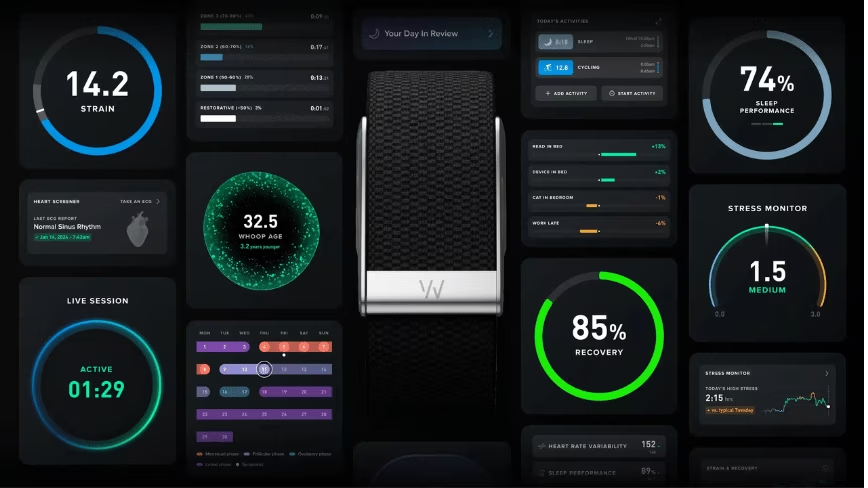
Just 24 hours later, Whoop—known for its subscription-based fitness bands favored by athletes—announced a very different upgrade: on-demand video consultations with licensed clinicians. Instead of an AI, Whoop is integrating telemedicine directly into its app. Users can now speak face-to-face with doctors, nurses, or mental health professionals who can review their Whoop data in real time.
Human Expertise in the Loop
Whoop's move acknowledges that while data is valuable, interpreting it often requires human judgment. A clinician can ask follow-up questions, notice nuances an AI might miss, and prescribe treatments or referrals. Whoop is betting that the trust factor of a real person—someone who can empathize and adjust advice based on conversation—will win over users who are skeptical of AI's ability to handle complex health issues.
AI vs. Human Expertise: A Head-to-Head Comparison
Both approaches have clear advantages and drawbacks. Google's solution is always available, never gets tired, and costs less over time. For routine questions and motivation, an AI coach can be surprisingly effective. However, critics worry about data privacy, the potential for incorrect advice, and the lack of a human touch when things go wrong.

Whoop's offering, while more expensive (the subscription includes the consultation fee, but it’s a premium service), provides the safety net of a licensed professional. A doctor can identify early signs of illness that an AI might misinterpret. But availability is limited—even on-demand consultations have wait times, and not every issue requires a doctor.
What This Means for You: Choosing Your Health Path
The divergence between Google and Whoop gives consumers a clear choice. Do you prefer a low-cost, AI-driven coach for daily wellness and minor guidance? Or are you willing to pay more for the confidence that a real human is watching over your data? Both options represent significant steps forward in making personalized health insights more accessible.
Consider Your Needs
- Budget: Google’s $99 device + $9.99/month is far cheaper than Whoop’s existing subscription (typically $30/month) plus any telemedicine costs.
- Seriousness: If you have chronic conditions or complex health concerns, Whoop’s human doctors may be safer.
- Privacy: Whoop has stronger medical data protections; Google’s AI data handling is under scrutiny.
The Future of Health Tech: Blended Models Ahead?
This rivalry is unlikely to end with a clear winner. The most likely outcome is a convergence: future devices may combine AI analysis with on-call human experts. For now, Google and Whoop represent two ends of a spectrum. Consumers gain the most from competition, and both innovations will push the entire wearable industry toward more actionable, personal health guidance.
Whether you choose the AI route or the human touch, the core message is the same: your health data has never been more valuable, and the tools to understand it are finally within reach.
Related Articles
- Building High-Performance LLM Infrastructure: Cloudflare’s Approach to Separating Input and Output Processing
- GPT-NL: The Netherlands' Bold Step Toward European AI Independence
- 8 Essential Strategies for Testing Code You Didn't Write (and Can't Predict)
- 7 Surprising Facts About ChatGPT's 'Strawberry' Breakthrough and Its Persistent Flaws
- Understanding Adversarial Attacks on Large Language Models
- The Battle for OpenAI's Soul: Inside the Courtroom Clash Between Elon Musk and Sam Altman
- Loopsy Launches: Open-Source Tool Enables Seamless Terminal and AI Agent Communication Across Devices
- OpenAI's GPT-5.5 Drives NVIDIA's Codex to 'Mind-Blowing' Efficiency Gains