Unlocking Efficient Inference: TurboQuant's KV Cache Compression
Introduction
As large language models (LLMs) scale to billions of parameters, the memory footprint of the key-value (KV) cache becomes a major bottleneck for inference. Traditional full-precision caching can quickly exhaust GPU memory, especially in long-context applications. Enter TurboQuant, a novel algorithmic suite and library recently launched by Google. Designed to apply advanced quantization and compression to LLMs and vector search engines, TurboQuant introduces a breakthrough approach to KV compression that dramatically reduces memory usage without sacrificing model quality.
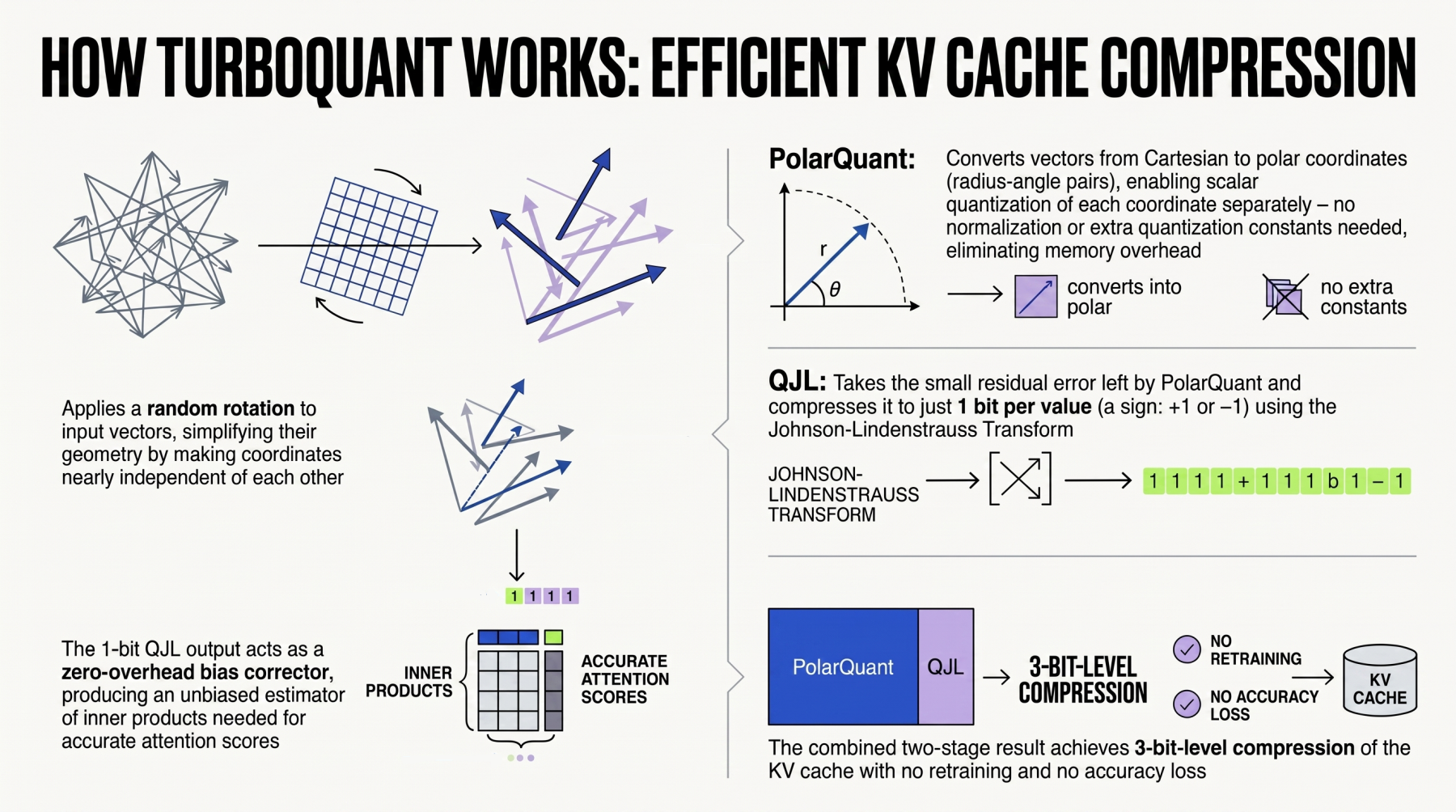
In this article, we explore how TurboQuant tackles the KV cache challenge, the techniques it employs, and why it's a game-changer for retrieval-augmented generation (RAG) systems and real-time LLM deployment.
The Challenge: KV Cache Memory Bloat
When generating tokens autoregressively, an LLM stores the keys and values from previous attention layers in a cache. For a model with 32 layers, a context length of 8K tokens, and 4K hidden dimensions, the KV cache can require more than 20 GB of memory in FP16 precision. This grows linearly with batch size and context length, limiting throughput and making long-context inference impractical.
Traditional compression methods—like pruning or low-rank decomposition—often degrade accuracy or require expensive retraining. Quantization, while promising, must carefully balance bit width with attention fidelity. TurboQuant addresses these trade-offs head-on.
TurboQuant's Methodology: Smarter Quantization
Group-wise Quantization with Dynamic Scaling
Instead of applying a uniform quantization scale, TurboQuant uses group-wise quantization, dividing the KV cache into small groups (e.g., 64 or 128 channels) and assigning each group its own scale factor. This preserves the statistical distribution of values, minimizing outliers that harm attention softmax calculations. Additionally, TurboQuant employs dynamic scaling that adjusts per-token activation statistics, ensuring robust performance even with variable input lengths.
Mixed-Precision Allocation
Not all KV entries are equally important. TurboQuant introduces a lightweight importance metric based on attention patterns—keys and values that contribute more to the final query receive higher bit-widths (e.g., 8-bit FP8), while less influential entries can be dropped to 4-bit integer quantization. This mixed-precision strategy achieves up to 4× compression with negligible loss in perplexity.
Hardware-Aware Kernel Optimization
TurboQuant is not just algorithmic; it includes optimized CUDA kernels for NVIDIA GPUs and custom operations for Google's TPUs. By fusing quantization with attention computation, the library eliminates memory bandwidth bottlenecks, achieving near-lossless throughput gains.
Key Benefits for LLM Deployment
- Reduced Memory Footprint: TurboQuant compresses the KV cache by 2–4×, allowing larger batch sizes or longer contexts on the same hardware.
- Maintained Accuracy: In benchmarks on LLaMA-2-13B and Gemma-7B, the perplexity increase remains under 0.1 after applying 4-bit KV quantization.
- Inference Speedup: With less memory traffic, end-to-end generation latency drops by 20–30% for long sequences.
- Plug-and-Play Integration: TurboQuant ships as a Python library that integrates seamlessly with popular frameworks like Hugging Face Transformers and vLLM.
Why TurboQuant Matters for RAG
Retrieval-augmented generation (RAG) systems rely on vector search engines (e.g., FAISS, ScaNN) to find relevant documents, then feed them as context to an LLM. This context often spans thousands of tokens, exacerbating the KV cache problem. TurboQuant directly addresses this by making it feasible to store and process long-context inputs without out-of-memory errors. Google's own Vertex AI Search already uses TurboQuant to serve RAG pipelines with 128K-token contexts.
Conclusion
TurboQuant represents a significant step forward in efficient LLM inference. By combining group-wise quantization, mixed-precision allocation, and hardware-aware kernels, it enables the compression of KV caches—the primary memory hog in autoregressive models—while preserving accuracy. For teams deploying LLMs in production, especially those building RAG applications, TurboQuant offers a practical, ready-to-use solution to scale and speed up inference.
Explore the official TurboQuant repository to start compressing your KV cache today.
Related Articles
- Your AI Era Begins: Jensen Huang's Commencement Wisdom for the Next Generation
- Kazakhstan Expands Access to World-Class Learning Through Renewed Coursera Alliance
- Coursera and Udemy Merge to Form World's Largest Skills Development Platform
- How to Fix Agent Authorization: A Step-by-Step Guide to Granular Access Control
- Python Tkinter Tutorial Unveiled: Build a Fully Functional Calculator GUI in Minutes
- Unraveling Python Memory Management: How CPython Handles Allocation, the GIL, and Internal Structures
- Your Step-by-Step Guide to Building Job-Ready Skills with Coursera's New Specializations
- The Essential Toolkit for Digital Nomads in 2026